CASE STUDY 1: Measuring and growing active modes of transport in Auckland
Auckland Transport conducted a survey to understand the behaviours and attitudes to the different modes of transport.
What we found use full in this case study:
This case study looked into both cycling and walking. However we are just looking at walking for our project.
Key Point to Point Walking:
Out of the four categories (to/from shops, to/from work, to/from study, to/from public transport), walking to the shops is where people are more likely to walk. Walking to/from study has the least amount of people walking.
Making stops on the journey:
The found that people walking to study were more likely to stop off a cafe/ or for food compared to the other categories. The are also the most likely to make any stops on their walk overall.
Motivation to walk:
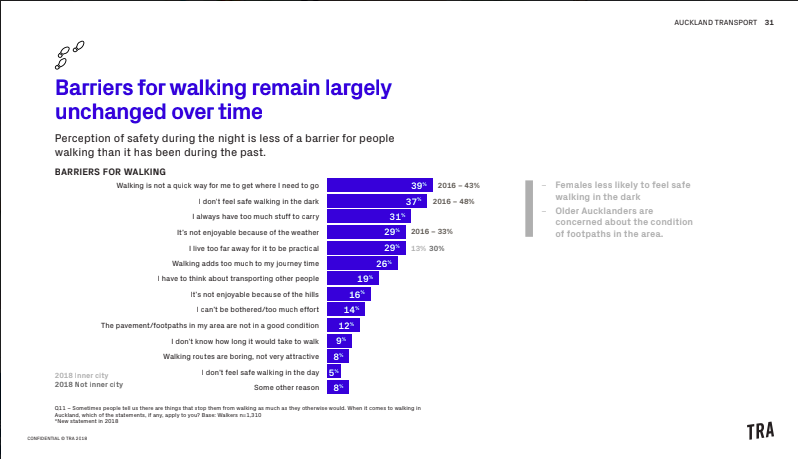
- Most people are motivated to keep fit. And more females and older people are likely to walk for fitness.
- People who are new to auckland walk to save time and money and have a consistent travel time.
- Provides some ‘me’ time also motivated people to walk. This could be good for students who need to take a break from their work and life.
Barriers to walk:
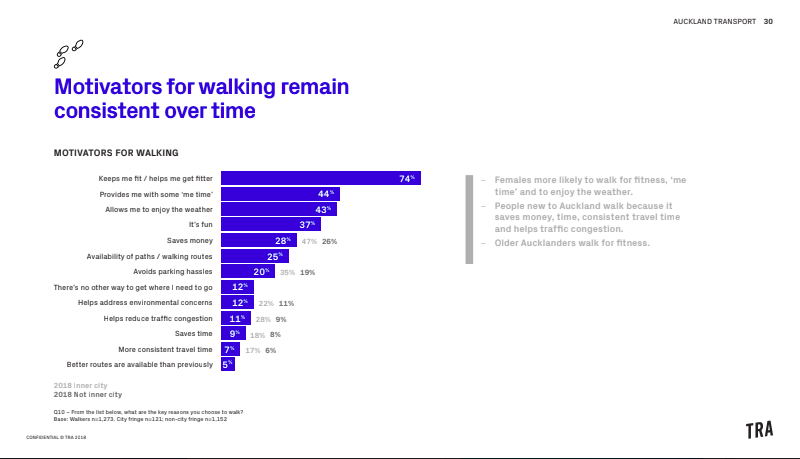
- The most common barrier to walking is that it takes to long.
- The next biggest barrier is that it is unsafe when it is dark and females are less likely to feel safe in the dark.
- Third biggest barrier is having too much/ too heavy to carry. This could be a problem for students as they often have to carry lots of things for classes.
Walking at Night:
Emotion: They do not feel safe walking at night
Infrastructure: Not enough lighting,
People: Gang/ Crime Rates are high
CASE STUDY 2: TASMANIAN GOVERNMENT STUDY
Objectives and Aims
- Reduce greenhouse gas emissions with walking and cycling.
- Make cycling and walking a more accessible form of transport to a lot of Tasmanians.
- Give a reliable journey for all citizens.
Costs:
The Tasmanian government says walking and cycling is cheap cost travel system so recommend especially to students and low income individuals or families.
Environmental Conditions:
- Road transport is linked to the quality of water around Tasmania.
- Air pollution
- The government thinks a change in short distance travel to environmentally friendly transport like walk or cycling can reduce greenhouse gas emissions in Tasmania.
- Most Tasmanians use a car to travel under 3 km.
Health Conditions:
We found in this case study that In Tasmanian 69% of people are in a good health condition but 41% people are overweight.
Inactive people are proven to be at risk of two diabetes, heart disease and some forms of cancer.
It is proven that 30 minutes of moderate activity everyday can help to lower the risk of diabetes, heart,disease,and osteoporosis.
Department of Infrastructure, Energy and Resources (2010). Tasmanian Walking and Cycling for Active Transport Strategy. Retrieved from: https://www.stategrowth.tas.gov.au/__data/assets/pdf_file/0004/88780/Tasmanian_walking_and_cycling_for_active_transport_strategy.PDF
Pokemon Go:
This case study reflects on what makes Pokemon Go successful.
The app Pokemon Go benefits customers and allows an interaction between consumers and businesses that is not purely business and purchase related, the interactions are based on socialising and having the presence of people around the desired companies, resulting in that there is more awareness of certain food chains and businesses.
What makes this application so successful is the combination of rewards, social interaction and fitness.
Through this case study we have learned that it is important to know the desires and needs and the mindset of the individuals that you are anticipating to sell your product to, the best way is to merge your project with the already formed preferences of consumers as this text explains very well and gives new understandings of the targeting of customer needs.
There are techniques used that are very powerful such as rewards systems as it explains in detail the “Compulsion loop: “A habitual, designed chain of activities that will be repeated to gain a neurochemical reward: a feeling of pleasure and/or a relief from pain.” (LHBS Consulting, 2016, p22).
“In games, the compulsion loop usually relies on a mix of anticipation, action and reward.” (LHBS Consulting, 2016, p22).
This is a very crucial thing to remember when designing our own app, we need to think about what people are dreaming about, their ideal visions they have and how we can integrate their desires into the application, and reward them for their participation and engagement to our walking and gaming application.
Not only are people on the streets using the application, but so are businesses who are also bringing a very humane and social perspective into their business model in that they are “offering incentives that improve the gaming experience.” (LHBS Consulting, 2016, p27).
This text explains what motivates customers, how people have grown to love an app on a large scale, and the ways that businesses can get involved with such an experience as Pokemon Go. A lot of this information has been useful in seeing which area’s of people’s needs are the most important to focus in on to draw large numbers of consumers.

 Transport and ACCESS